SubKick User Manual
Welcome to SubKick! Give your kick a little more weight, tune its low end to your track, or build a longer sub tail. This guide walks you through the controls so you can find the balance that works for your music.
Start with General Workflow for a quick first session, or jump to a specific section below. Need a hand? Our Frequently Asked Questions are a good place to start.
1. Help
Click the question mark in the header to enable hover explanations for the controls and displays.
2. General Workflow
- Insert SubKick on a percussion track, in most cases a kick drum.
- Use the Tuning knob to choose a note, or click the MIDI socket icon and route MIDI notes into SubKick.
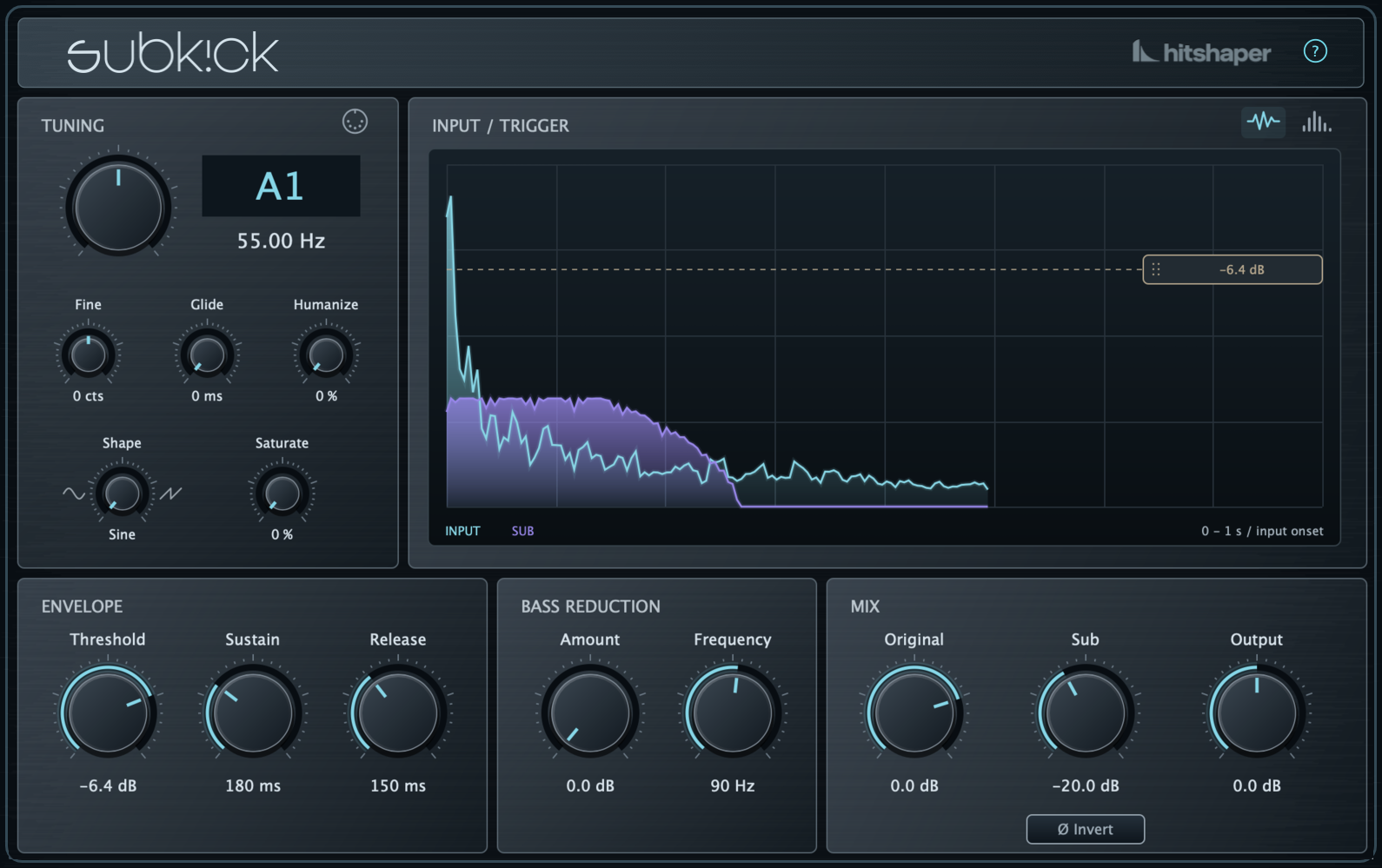
- Adjust threshold control or drag down the dashed threshold line in the metering section. The transients should go slightly over to trigger the synthesizer.
- Set Sustain and Release for the tail, then add Shape and Saturate to taste.
- For continuous 808 slides, overlap your MIDI notes and turn up Glide.
3. Signal
Tuning & Frequency
Choose from the available note frequencies. It ranges one octave from D#1 (38.89Hz) to D2 (73.42Hz).
MIDI Follow
Try MIDI Follow for big, melodic 808-style bass lines: send in your bass notes, use the kick to trigger each hit, and lengthen Sustain and Release for a deep, ringing tail that follows your melody.
Route MIDI into SubKick and click the MIDI socket icon. It lights up when enabled. The most recent Note On selects the pitch class within D#1–D2, regardless of the incoming octave. The kick audio still triggers the envelope; MIDI notes alone do not start a sound. Note Off for the most recent note and MIDI channel stops a running sub with a 10 ms fade, independently of Sustain and Release. Releasing an older note does not stop a newer one. The last pitch stays selected for the next kick. Fine and Humanize remain active. Switch MIDI off to return to manual tuning.
Fine
Tune the frequency in cents.
Glide
Set the transition time between MIDI pitches from 0 to 1000 ms. Short times give subtle slides; longer times let the bass travel between notes. At 0, only the short smoothing needed for a click-free pitch change remains. Glide works while a sub is sounding; a newly triggered voice starts at the selected pitch.
Overlap your MIDI notes for continuous slides. The next Note On must arrive before the previous note’s Note Off. Without that overlap, Note Off starts the 10 ms stop. A new note during a slide continues from the current pitch.
Humanize
Adds small variations in pitch for a less uniform sound. Use lower values for subtle movement, or set it to 0% for a fixed pitch.
Shape
Blend from a pure sine wave to 20% saw. The left end gives the cleanest sub; moving right adds restrained harmonics without changing the selected note. The sine and saw symbols show the direction. Double-click to return to pure sine.
Saturate
Add saturation to the generated sub from 0 to 100%. Higher settings bring out harmonics, with gentle level compensation and softened upper frequencies to retain the bass foundation. At 0% the saturation is off. The original kick is unaffected; use Sub in the Mix section to set the generated signal’s level.
Saturation uses internal 4× oversampling to reduce aliasing when adding harmonics. This is handled automatically, with no extra setting required.
Threshold
Sets the threshold that must be passed by transients to trigger the synthesizer. This parameter can also be set graphically in the metering section.
Sustain
Sets how long the sub holds before Release, from 50 to 3000 ms. A new detected kick restarts the hold. MIDI Note Off can end the tone earlier.
Release
Sets the fade after Sustain, from 20 to 5000 ms. MIDI Note Off uses its own 10 ms fade instead.
4. Bass Reduction
Use Amount to attenuate low frequencies in the original kick before the Original gain control. Frequency sets the transition between 30 and 250 Hz. At 0 dB the filter is bypassed; at −∞ it becomes a 36 dB/oct high-pass, with Frequency setting its −3 dB cutoff. Detection and sub synthesis still use the unfiltered input.
5. Mix Section
Sub
Amount of the generated signal. The Invert button below inverts the polarity of the generated sub-bass.
Original
Adjusts the level of the original signal after Bass Reduction.
Output
Adjusts the output level of the sum.
6. Waveform & Spectrum Analyzer
Waveform shows a one-second view of each detected input hit. Cyan is the original input; violet is the generated sub. Quiet hits remain visible even when they do not cross the sub threshold.
Spectrum compares the original signal after Bass Reduction (cyan) with the generated sub (violet). The logarithmic frequency axis runs from 20 Hz to 20 kHz, limited by the sample rate. The display is measured before Output gain; the original trace is also before Original gain.
Drag the dashed threshold line or its handle in either mode to adjust Threshold. Trigger detection always measures the unfiltered input peak, not individual spectrum bands.
7. Appendix
System Requirements
Windows 10 (22H2) or later, 64-bit (x64). Windows 11 recommended.
macOS 12.0 or later (Intel and Apple silicon)
DAW with support for Audio Units / VST3 / AAX / CLAP
SubKick supports sample rates of up to 192kHz.